
America’s First Socialists–and Why They Rejected It
Two celebrations took place recently that couldn’t be more opposite.
Socialism and Thanksgiving.
Many people applauded the election of two socialist mayors in America (New York and Seattle). Others gathered with family and friends to praise God for his blessings.
Socialism feeds on envy. Thanksgiving centers on gratefulness.
Here’s a quick primer on the two and why the Pilgrims rejected socialism.
America’s First Socialists–and Why They Rejected It
My main focus today will be on the economic evils of socialism while helping to define it. For many people, the term “socialism” sounds cool, almost like social studies in middle school.
But socialism is anything but benign. Here are the some basic contrasts between the worldview of socialism and the Truth found in biblical faith.
- Socialism is the economic theory of atheism. Most socialists are secularists (if they are consistent with their worldview). Capitalism or free enterprise is the economic application of biblical ideas. It’s true that some non-believers like capitalism (like Richard Dawkins who supports “cultural Christianity”). Conversely, some believers like socialism due to ignorance of its true motivation and evil fruits.
- The word “socialism” springs from the idea that problems in our world are primarily “social” in nature. We have oppressors and the oppressed. Thus we must change “society.” Biblical reality teaches that groups are not the problem–it is found in individual sin and guilt. God provides a way for individuals to be saved from their sins through Jesus Christ. In truth, the two primary camps in the world are the saved and the lost.
- Because socialists don’t believe in individual sin, they are sympathetic toward criminals, not the people they harm. People of faith believe that criminals are responsible for their crimes and should be punished and restrained from hurting the innocent.
- Socialism at its heart is the breaking of the seventh, ninth and tenth commandments. Socialists envy the industrious/successful and want to take their wealth and give it to others. They believe that’s fair and compassionate. The Bible teaches individual responsibility (hard work) brings the blessing of God, and that we should not not compare our lives with others. You “reap what you sow” is fair. Compassion is voluntary and a deep part of God’s heart for the diligent poor.
- Socialism leads to tyranny and death (Nazis, communists, abortion providers etc.) 100 million people were slaughtered at the hands of socialists in the 20th century (not including the one billion babies that died from the abortion holocaust). Faith in Jesus leads to freedom and prosperity in nations that follow God’s commands.
I will let well-known journalist John Stossel make the case against socialism from the early example of the Pilgrims. Stossel is an atheist/agnostic, but his economic worldview is thoroughly biblical.
Thanksgiving Socialism
by John Stossel
People are turning to socialism. Two-thirds of Americans ages 18-29 hold a “favorable view” of it. New York just elected a “proud socialist” mayor. My video explains why his ideas would make things worse. Of course they would! Socialism has never worked. Anywhere.
Yet Seattle too just elected a socialist mayor. “Let’s give socialism a chance,” said a student writing in The Student Life, a college newspaper.
Americans should know we already gave socialism a chance. The only reason we get to celebrate Thanksgiving with lots of food is because the Pilgrims learned (the hard way) that socialism doesn’t work.
When they came to America, they first tried sharing land. Gov. William Bradford decreed that each family would get an equal share of food, no matter how much they worked. The results were disastrous.
Few Pilgrims worked hard, claiming “weakness and inability,” wrote Bradford. “Much was stolen.” The same plan in Jamestown led to starvation, the death of half the population, even cannibalism.
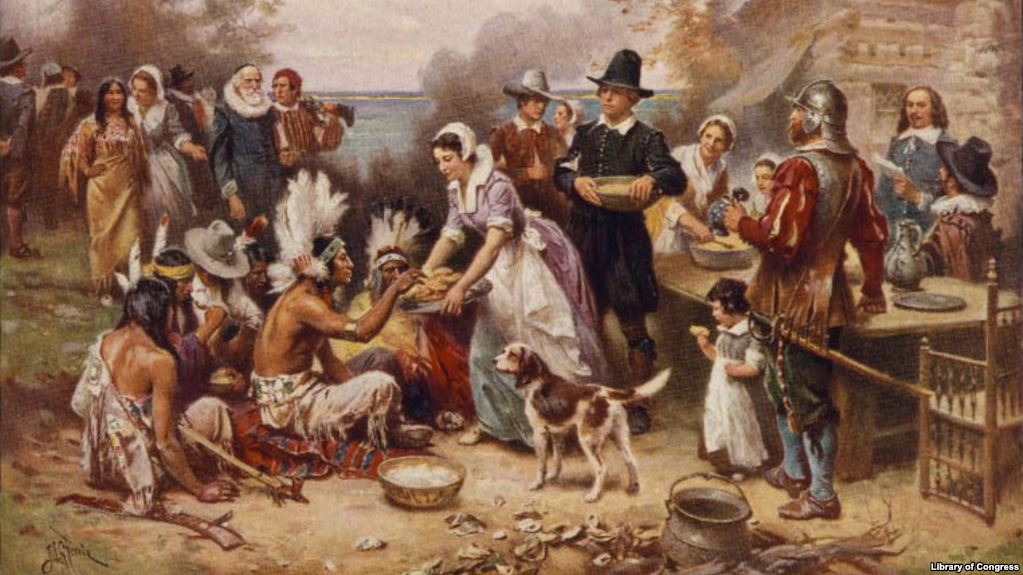
Learning from their mistakes, the Pilgrims tried a different approach: “Every family was assigned a parcel of land,” wrote Bradford. Then, he noted, Pilgrims “went willingly into the field.” That’s capitalism. Soon, there was an abundance of food. So much that the Pilgrims and Natives could celebrate Thanksgiving together.
This abundance has only grown.
We’ll feast on vast amounts of food this Thanksgiving that, despite media clickbait, is much more affordable than it used to be. Today Americans spend only 10% of our disposable income on food. When I started working, it was twice that. This abundance didn’t come with people in government manipulating supply chains, or comrades dictating prices and quality.
It comes from millions of people practicing capitalism, making billions of voluntary exchanges. It comes from free people willing to innovate and take risks, in an attempt to make more money by serving customers better than the next guy. This process almost always works better than government central planning.
Without central direction, farmers, truckers and grocers move food across the country with remarkable coordination and efficiency. Stores compete so fiercely that they sell turkeys at a loss, just to get you through their doors. Global competition drives airlines to lower their fares so it’s cheaper for you to fly home for Thanksgiving.
And despite the media’s alarms about climate change creating food shortages, global agricultural output sets record highs year after year. Government didn’t orchestrate any of that. Government can barely manage a DMV line.
Markets create abundance because they quickly reward people who figure out how to make things cheaper, faster and better. That’s what I’m thankful for this Thanksgiving. The alternative looks a lot like Venezuela, Cuba, North Korea … While we enjoy the gifts that free enterprise brings, AP reports that in Venezuela, “every meal is a struggle.”
NBC, before going on to write silly stories that practically promote socialism, admits that in Cuba, residents face “daily blackouts lasting up to 20 hours, mounting piles of uncollected garbage, and severe shortages of food and basic goods.” When politicians try to control the economy, the abundance you get is scarcity.
We live in a country where choices overwhelm us, and shortages are something we read about in the news. It should make us grateful. Not just for the food, but for the free enterprise system that creates it.
This Thanksgiving, as you go around the table to say what you’re thankful for, take a moment to thank the farmers, truckers, pilots, grocery workers, engineers, entrepreneurs, and most importantly, the economic freedom that makes it all possible.
Let’s not let socialist idiots kill it.
Abundance doesn’t happen by accident. It won’t continue if we forget where it came from.
* * *
One of the favorite books in my library is The Christian History of the Constitution of the United States of America by Verna Hall and Rosalie Slater. It contains a wealth of primary sources (eyewitness accounts) of American history.
One of those accounts is Pilgrim governor William Bradford’s History Of Plymouth Plantation which Stossel refers to above. Here is Bradford’s summing up quote on our Pilgrim forefathers rejecting socialism:
The experience [of socialism] that was had in this common course and condition, tried sundrie years, and that amongst godly and sober men, may well evince the vanity of that conceit of Platos and other ancients, applauded by by some of later times–that the taking away of property, and bringing in community into a common wealth, would make them happy and flourishing–as if they were wiser than God.”
Translation: Socialism didn’t even work among a godly people. The Greek philosophers and moderns are wrong. They think they are smarter than God.
That’s foolish.
It’s only God’s wise principles that bring freedom and blessing to those who practice them.


This is the most straightforward guide I’ve seen, thanks.
Thanks for the encouragement. I try to make complex subjects as simple as possible as a service to people.
Socialism as opposed to capitalism is a very important subject to understand if we want to remain a free people.
God bless you and Merry Christmas.
Ron